
Attorneys’ billable hours – the time spent on client work that can be invoiced – are the lifeblood of a law firm’s revenue. For example, one review notes that billable time “plays a pivotal role in the profitability and success of law firms,” serving as a key performance metric for meeting firm targets. A typical firm may set annual billable targets on the order of 1,700–2,300 hours per lawyer, making precise time tracking essential. A billable hours chart is a simple tool used by lawyers to convert minutes of work into decimal fractions of an hour, ensuring accurate billing for every task performed
What Are Billable vs. Non-Billable Hours?
Billable hours are the client-related tasks an attorney can charge for. This includes work like meeting with a client, drafting legal documents, preparing for and attending court hearings, and conducting research directly tied to a case. These activities directly benefit a client’s matter and are billed at the attorney’s hourly rate. By contrast, non-billable hours are work that supports the firm or the profession but cannot be charged to clients. Examples include internal administrative tasks (like bookkeeping or marketing), attending firm meetings, business development, training, or pro bono work. Both categories are essential to the practice, but only billable hours generate revenue for clients.
Billable hours: Client meetings, drafting pleadings, legal research, court appearances, responding to client communications – tasks directly advancing a case.
- Non-billable hours: Administrative work, internal firm meetings, reporting or billing tasks, continuing education, business development – necessary activities not invoiced to clients
What Is a Billable Hours Chart?
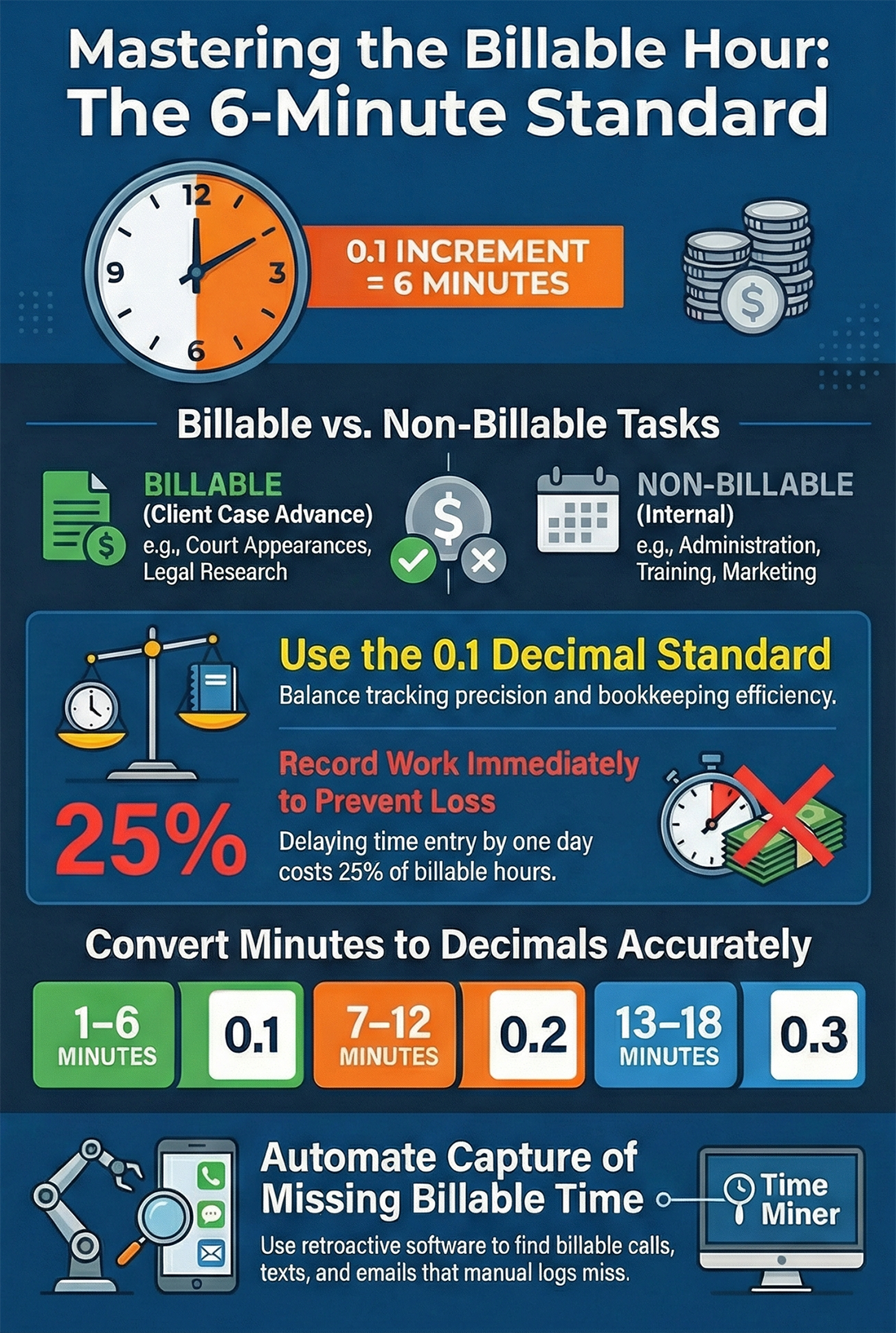
A billable hours chart is a standardized template that helps lawyers quickly compute how much of an hour to bill for a given task. Rather than tracking every minute or simply rounding to the nearest hour, attorneys break each hour into equal increments. The most common approach is to use decimal tenths of an hour (six-minute increments). For example, a chart might list that 1–6 minutes = 0.1 hour, 7–12 minutes = 0.2 hour, up to 55–60 minutes = 1.0 hour. By following the chart, an attorney converts the minutes worked into the corresponding decimal fraction.
Figure: Attorneys often rely on simple charts to convert minutes of work into decimal billable hours. These templates make it easy to translate time on tasks (such as calls, email, or drafting) into billable increments.
These charts create a consistent method for logging time and calculating fees. Lawyers can use any increment (some firms use 10- or 15-minute blocks), but breaking hours into tenths (6-minute chunks) is widely considered the industry standard. By using a billable hours chart, firms reduce errors in invoicing: each task’s time is clear, and the client sees a transparent breakdown of how hours were billed
Why Use Six-Minute Increments?
Six-minute increments (one-tenth of an hour) strike a balance between precision and efficiency. Recording time in smaller units (say, every minute) would be overly tedious, while larger blocks (like 15 minutes) can exaggerate the time spent on quick tasks. As one legal guide explains, “billing in tenths of an hour makes calculations easier […] without rounding up by too much,” giving clients fair value while keeping bookkeeping manageable. In practice, most attorneys round up to the nearest six-minute mark. Even if a task takes only a few minutes (for example, a 3-minute phone call), it is common to bill at least 0.1 hour (six minutes).
Using six-minute increments helps firms avoid both underbilling and overpadding. Smaller increments are simply impractical to track manually, and larger increments (like billing by half-hour or quarter-hour) can lead to significant overcharges for brief tasks. Thus, the tenth-of-an-hour chart is a “fair compromise” that provides accuracy and flexibility. It is an accepted norm across private and government law practice, ensuring invoicing is transparent and clients understand exactly what they’re paying for?
Common Billing Increments and Charts
While six-minute (0.1-hour) increments are most common, some firms use other billing increments depending on preference or client agreements. For example, quarter-hour increments (15-minute blocks) are sometimes used. In that scheme, 1–15 minutes = 0.25 hour, 16–30 = 0.5, 31–45 = 0.75, and 46–60 = 1.0. Some practices might round to the nearest half-hour (30-minute chunks), or even bill in one-hour units for very predictable work.
Regardless of increment length, the idea of a billing chart remains the same: it’s a reference table to convert minutes into billable-hour fractions. Below is an example of a typical six-minute increment chart (tenths of an hour):
Figure: Sample billing chart converting minutes worked into decimal hours using six-minute increments. For instance, a 14-minute task becomes 0.3 hour (30% of an hour)
Charts can be made for any increment system. For instance, Time Miner notes that attorneys often create charts based on “6-minute or 12-minute” increments, and any fraction of a minute is usually billed as the next full increment. This means even very short tasks get a minimum billing time. The important point is consistency: whichever system is used (tenths, quarters, etc.), the chart ensures everyone in the firm bills the same way and clients see a clear, itemized invoice.
How to Calculate Billable Hours
Using a billable hours chart is straightforward. First, record the actual time spent on each task. Then, look up that time in the chart to find the corresponding decimal increment, and multiply by the attorney’s hourly rate to calculate the charge. For example, if an attorney spends 15 minutes drafting a memo and bills at $200/hour, the chart shows 15 minutes = 0.3 hour. The billed amount is then $200 × 0.3 = $60. Likewise, if a task took 34 minutes on an hourly rate of $300, the chart indicates 34 minutes ≈ 0.6 hour, so the invoice line is $300 × 0.6 = $180.
In practice, calculating each entry goes like this:
- Find the time range: Note how many minutes the task took (e.g., 14 minutes).
-
Use the chart: Look up that minute range in the billable hours chart to get the billed increment (for 13–18 minutes, you’d bill 0.3 hour).
Record the entry: Enter the decimal hour (e.g. “0.3”) in the time log.
- Multiply by rate: To determine the fee, multiply the decimal hours by the attorney’s hourly rate. For example, 0.3 hours at $100/hr = $30.
By following the chart for every task (no matter how small), attorneys ensure no billable work is missed or double-counted. This method minimizes arithmetic errors and standardizes billing. (Many firms now use automated calculators or software to do this conversion, but the underlying chart still guides the math.)
Why Billable Hours Matter
Tracking billable hours accurately is critical for both lawyers and clients. For law firms, billable time is the currency of revenue. Meeting or exceeding billable targets is often tied to attorneys’ performance reviews and bonuses. In fact, firms typically calculate those targets based on cost and revenue goals: one analysis notes that the “billable hour requirement…is calculated based on the firm’s operational costs, expected revenue and market standards,” making it a key performance indicator. Achieving these targets can lead to extra compensation, while falling short may mean lost productivity.
For attorneys, understanding and maximizing billable hours helps ensure they are fairly compensated for their work. It also allows attorneys to measure how efficiently they are working. If a lawyer can only log a few hours of billable work in a day, it signals either a need to streamline their workflow or to delegate non-billable tasks. Indeed, studies show that many lawyers bill far less than firm expectations. One report finds attorneys spend only about 2.9 hours each workday on billable work, despite much higher targets. That gap highlights the importance of diligent timekeeping – otherwise a firm leaves money on the table.
From the client’s perspective, transparent billable time records build trust. Clients want reassurance that they are billed precisely for the lawyer’s work, no more and no less. Detailed charts and descriptions help clients see that each minute of work is justified. Altogether, accurate time tracking and billing charts protect both the firm’s profitability and the client-lawyer relationship.
Average Billable Hours Expectations
Law firms traditionally set high expectations for annual billable hours. For example, associates at small to midsize firms might be expected to log around 1,900 hours per year, while at large firms those targets can approach 2,000 or more. To put this in context, 1,800 billable hours equates roughly to working an extra 20 minutes each weekday beyond a normal 40-hour week, or one full weekend per month. Going up to 2,200 hours might require a schedule like 8:00 a.m. to 8:00 p.m. Monday–Friday and additional work on Saturdays.
Broken down monthly, 1,900 billable hours is roughly 158 hours per month. When planning, attorneys must also account for non-working days (vacation, holidays, etc.) because those do not count toward the billable total. It’s worth noting that these targets are averages – individual output may vary based on experience and practice area. Still, most firms maintain a ballpark range: “The goal is between 1,700 and 2,300 hours,” as one industry guide observes. Attorneys often learn quickly that meeting or exceeding the firm’s billable hour goal is vital to their career growth and to the firm’s financial health.
However, as mentioned above, actual billed hours can fall short of targets. Recent data from a legal industry report indicate that the average lawyer bills only a fraction of an eight-hour day to clients. This gap makes efficient time management and accurate billing charts all the more important, since every billed tenth of an hour represents real earnings.
How to Track Time Effectively
Even with clear charts and policies, tracking every billable minute takes diligence. The best practice is to log time as you work, rather than relying on memory at day’s end. Real-time tracking is far more accurate: one study cited by a billing guide notes that failing to record time immediately can cost attorneys 10% of their billable hours by the end of the day, 25% by the next day, and up to 50% if waiting a week. Small calls, quick emails, and hallway consultations – these “micro-moments” easily fall through the cracks and collectively amount to substantial revenue loss.
To minimize lost time, lawyers should adopt these strategies (drawn from industry best practices):
- Use a Billable Hours Chart or Tool: Always keep a reference (like a chart or a mobile app) to convert minutes into billable hours. This ensures no billable work goes unrecorded.
Track Time in Real Time: Enter each task as soon as it is done. Recording time on-the-go ensures accuracy and prevents costly omissions.
Write Detailed Descriptions: Note what you did for each time entry. Clear descriptions jog your memory if a client questions a charge, and they make invoices transparent.
Communicate with Clients: Be transparent about your billing rates and policies from the outset. Regularly updating clients on hours spent builds trust and avoids surprises.
- Use Technology: Time-tracking software can automate much of this process. Tools designed for legal billing can capture calls/emails, pop up reminders to log time, and integrate with practice management systems.
By combining a reliable chart with disciplined habits, attorneys can capture virtually all billable time. This not only boosts revenue but also gives lawyers control over their workload, as they see exactly how their time is spent each day.
How Time Miner Captures Every Billable Minute
Even with best efforts, human memory and manual logging will miss things. This is where automation comes in. Time Miner is a tool built for exactly this purpose: to find and log any client-related billable work you might have missed. As a Retroactive Legal Timekeeping Software, It works by scanning your communications (emails, phone calls, texts) and retroactively suggesting time entries tied to your cases.
Think of it as a safety net for timekeeping. Time Miner securely integrates with your email and phone systems: it links call logs and messages to your client/matter data. In effect, every client call, email thread, or text message is automatically identified and converted into billable time entries. You don’t need to set timers or jot notes – Time Miner “remembers” those micro-tasks for you. Once imported, you can review and approve the entries. Completed work that might otherwise slip through the cracks is now captured as revenue.
This automation stops the so-called “time leakage” that plagues many firms. By eliminating manual logging errors, Time Miner ensures every billable minute is accounted for. It even pushes entries straight into practice management systems, so invoices are complete and clients are billed correctly. The result? Attorneys can focus fully on their cases, knowing that Time Miner is quietly mining their inbox and phone logs to recover lost hours. As one industry insight put it: “automated time capture is reshaping law firm operations”, and firms that embrace it bill more and work smarter.
In short, Time Miner extends the traditional billable hours chart concept into the digital age. It works in the background of your normal workflow, integrating with Outlook, Gmail, and phone systems. By combining Time Miner’s automated capture with disciplined chart-based tracking, law firms can ensure maximal billing accuracy and profitability without adding extra burden on the lawyer’s day.
Conclusion
For legal professionals, mastering billable time charting is a blend of precise record-keeping and good tools. A standardized chart – most often using six-minute increments – simplifies converting work into billable units. Consistently applying these charts ensures clients see transparent, detailed invoices and firms capture every hour owed. At the same time, attorneys must practice smart time-tracking habits (logging time in real time, using detailed descriptions, and leveraging software) to avoid leaving money on the table. Tools like Time Miner further help by automatically detecting missed billable work in calls, emails, and texts.
By understanding what billable hours are and using a billing chart effectively, lawyers uphold accuracy in billing and firm profitability. In a high-pressure legal environment, these methods ensure no billable minute goes unnoticed – benefiting firms and clients alike.
Retroactive Legal Timekeeping Software — Start Your 30-Day Free Trial to begin recovering missed billable time today.
Frequently Asked Questions (FAQs)
Q.1 : How do I calculate decimals for time spent on a task?
A : To calculate the decimal value of your billable time, divide the number of minutes worked by 60. For example, if you worked on a motion for 45 minutes, the calculation is 45 ÷ 60 = 0.75. Most firms using the six-minute increment would round this to 0.8 to align with the standard 1/10th of an hour billing model.
Q.2 Why do most law firms use six-minute billing increments?
A: Six-minute increments (0.1 hour) provide a practical balance between precision and efficiency. They allow attorneys to bill fairly for smaller tasks without excessive rounding while keeping calculations simple and consistent.
Q.3 How does a billable hours chart help attorneys?
A: A billable hours chart converts minutes worked into decimal values of an hour. This standardization reduces billing errors, ensures consistent invoicing, and helps attorneys quickly calculate charges based on their hourly rates.
Q.4 How can I capture billable time for client communications on my mobile phone?
A: Manual tracking for mobile communication is notoriously difficult and often leads to thousands of dollars in "lost" time every year. This is where Time Miner excels. By retroactively mining your call, email and text logs and cross-referencing them with your contacts, Time Miner identifies these billable moments and creates entries automatically, ensuring you are paid for the work you do outside of your office.
Q.5 What is "block billing" and why is it discouraged?
A: Block billing is the practice of lumping multiple different tasks into a single time entry (e.g., "4.0 hours for research, phone calls, and drafting"). Clients and insurance companies often reject these entries because they lack transparency. It is more effective to break these down into granular, 6-minute increment entries to show exactly how much value was provided for each specific task.